
Enterprise marketing teams have never had more tools, more budget, or more AI at their disposal. And yet, most of what they produce never reaches a customer.
With Adobe Summit 2026 opening this week (April 20-22), here are 11 data points that expose the growing gap between content production and content impact.
1. Most Enterprise Content Does Not Work. And the Teams Creating it Cannot Even Measure Why
The content waste problem in 2026 is not a perception. It is a documented budget crisis:
- Most enterprise content is underperforming. Only 44% of marketers say their content efforts actually drive conversions
- Large organizations waste an average of $2.5 million annually on inefficient content processes: missed deadlines, duplicated work, and version chaos
- One enterprise marketer reported spending 6-8 hours per week just tracking down "where things are" in the production pipeline
AI tools have only accelerated the problem, making it easier than ever to produce material that adds little value. The modern marketing engine does not need more content. It needs a content detox.[1] & [2]
2. Content Operations Waste $2.5 Million Annually. 77% Say AI has Increased their Workload
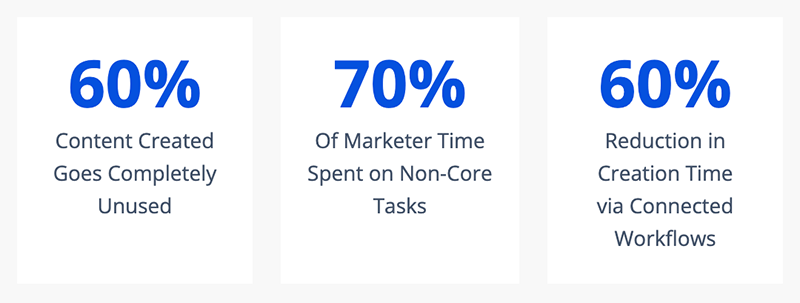
Aprimo's 2026 data puts the annual cost of inefficient content processes at $2.5 million per large organization. A counterintuitive finding:
Deloitte reports 77% of workers say AI has increased their workload.
AI makes creation faster but creates downstream chaos with more assets to tag, approve, distribute, and govern. [2]
3. 60% of All Content Created Today Goes Unused. Teams Spend 70% of their Time on Non-Core Work
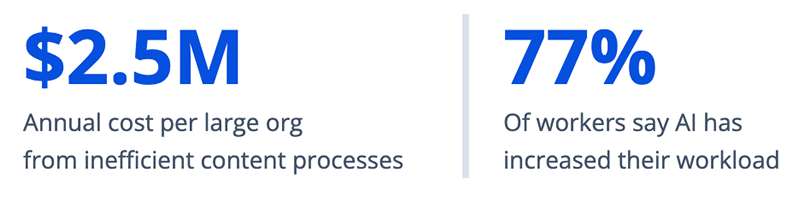
- 60% of all content created today goes entirely unused
- Marketing teams spend nearly 70% of their time on fragmented systems and manual processes
- Teams that shifted to connected workflows reduced content creation time by up to 60%
The content factory model was built for a linear world; it is collapsing. [3]
4. Only 44% Say their Data Quality is Adequate for AI. Just 39% Have a Shared CDP
Adobe's 2026 AI and Digital Trends report (with Oxford Economics, surveying 3,000 executives and 4,000 customers) reveals:
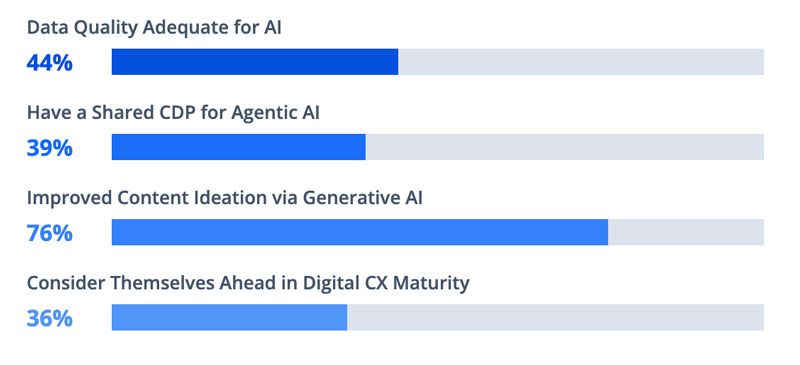
- Only 44% believe their data quality is adequate for AI
- Just 39% have a shared CDP capable of supporting agentic AI
- 76% report improvements in content ideation from generative AI, but only 36% consider themselves ahead in digital CX maturity
You cannot personalize what you cannot connect. [4] & [5]
5. 50% of the Customers Give You 2-5 Seconds. 45% will Disengage Even from Relevant Over-Promotion
Adobe's consumer survey surfaces the brutal reality:
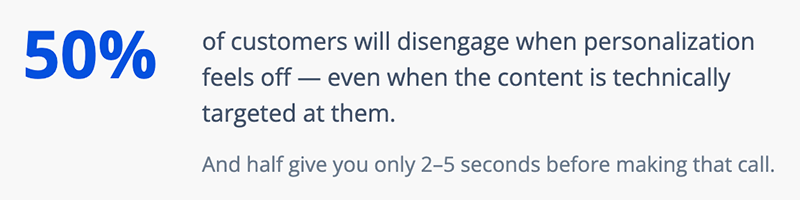
- Half of customers give promotional content only 2-5 seconds; one-fifth judge in under two
- 45% will disengage from too many promotions, regardless of relevance
- 50% disengage when personalization feels off or irrelevant
More content actively shrinks the window. The drivers of engagement are immediate personal relevance, unique content, and authenticity.[6] & [7]
6. 84% Say AI Improved Productivity. Only 44% Say it Drives Conversions
The Content Marketing Institute's 2026 Enterprise Report and MarketingProfs research reveal the efficiency trap:
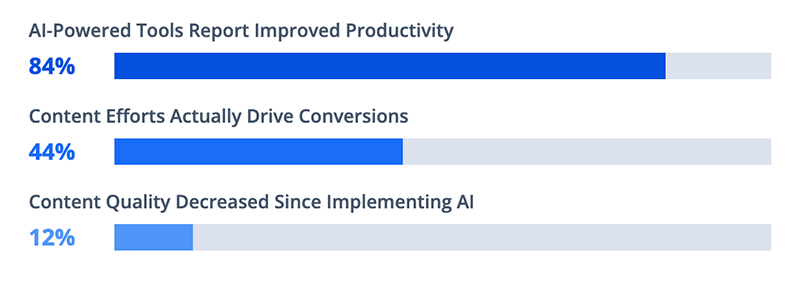
- 84% of enterprise marketers using AI-powered content tools report improved productivity
- But only 44% of marketers say their content efforts actually drive conversions
- 12% say the quality of their content has actually decreased since implementing AI
- Top challenges: resource constraints (42%), measuring effectiveness (38%), cross-departmental collaboration (36%)
AI is making teams faster at producing content that does not convert. That is the most expensive kind of efficiency.[8] & [9]
7. 25% of Customers Now Use ChatGPT as their Top Research Tool Ahead of Brand Websites
The distribution crisis compounds the creation crisis:
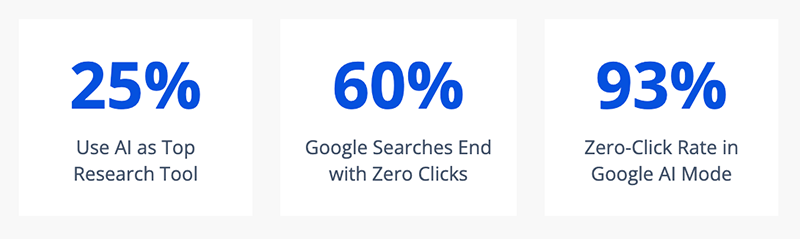
- 25% of customers use AI platforms like ChatGPT as their top research tool, ahead of brand sites, reviews, or traditional media
- 60% of Google searches now end without a click. On mobile, that climbs to 77%
- In Google's AI Mode, the zero-click rate hits 93%
- Organic click share dropped 11-23 percentage points year-over-year across every measured vertical
Brands are producing more content for channels where fewer people will ever see it. .[10], [11] & [12]
8. Adobe's Answer at Summit 2026: GenStudio is Evolving into an Autonomous Content System
At Summit 2025, Adobe introduced the Experience Platform Agent Orchestrator and 10 purpose-built AI agents. At Summit 2026, Everest Group describes GenStudio as the kernel of autonomous content systems where generation, delivery, and iteration form a single continuous loop.
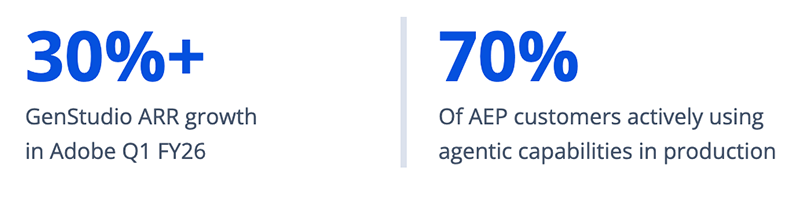
Adobe's Q1 FY26 results show GenStudio Annual Recurring Revenue grew over 30% and 70% of all Adobe Experience Platform (AEP) customers are now actively using agentic capabilities in production.
But Merkle warns: most enterprises have not unified their data foundations, and these agents require AEP Prime or Ultimate editions that most have not earned ROI from yet.[13], [14] & [15]
9. The Real Metric is "Share of Model": How Often AI Recommends Your Brand
The shift from human browsing to AI-driven discovery creates a new competitive metric:
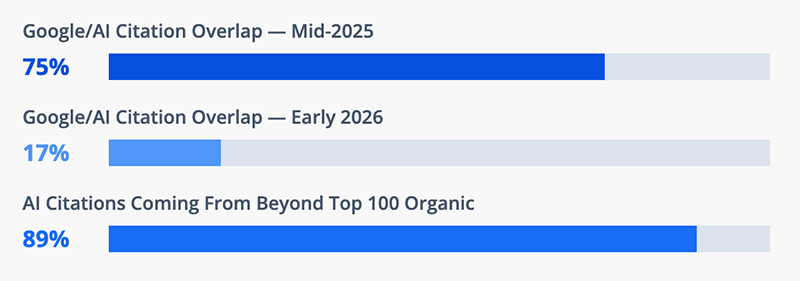
- Google rankings vs. AI citations overlap collapsed from 75% (mid-2025) to 17-38% (early 2026)
- 89% of AI citations now come from beyond the top 100 organic listings
- Yet AI-referred traffic converts 4.4x higher than standard organic search
Your SEO investment is increasingly decoupled from AI visibility. The brands that win will be the ones AI trusts enough to cite.[16] & [17]
10. 49% of Organization Think Customers Want AI Agents as Primary Touchpoint. Only 19% Actually Do
Adobe's 2026 research surfaces a dangerous perception gap:
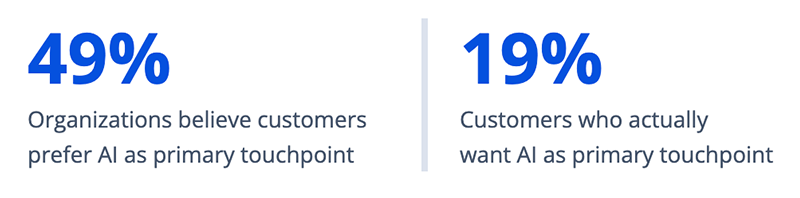
- 49% of organizations believe customers want AI agents as their primary brand interaction
- Actual customer response: 19%
- 43% are willing to try a brand's AI concierge, but far fewer would let an agent share personal data or make purchases
- The top trust factor: the ability to switch to a human at any time [18] & [19]
11. The Winning Move is Not More Content. It is Content Intelligence
The enterprises winning in 2026 produce the most valuable content, not the most content:
- CMI confirms the shift from content volume to content orchestration
- McKinsey found only 6% of organizations qualify as AI high performers. The common thread: they redesigned workflows before deploying AI, not after
- Teams that cut content creation time by up to 60% did it through connected workflows, not more AI tools
The strategy: audit ruthlessly, orchestrate what remains, become the brand AI cites.[20], [21] & [22]
GSPANN's Perspective: Your Content Supply Chain Needs a Complete Rewire
The content supply chain most enterprises run today was designed for a world where humans searched, browsed, and clicked. That world is disappearing. What is replacing it demands three capabilities:
- Unified data foundations: Only 39% have a shared CDP. Without it, personalization is guesswork.
- Content orchestration architecture: Systems that connect ideation, creation, approval, distribution, and measurement into a single intelligent loop.
- AI-readiness of structured data: Schema markup, real-time data sync, and machine-readable content are the new table stakes for AI discoverability.
GSPANN's Digital Experience practice works across Adobe Experience Platform, GenStudio, AEM, and Real-Time CDP to help enterprises build content intelligence systems where every asset is connected, governed, and discoverable by both humans and machines.[23] & [24]
We're attending the Adobe Summit this year (April 20-22). Know someone who's a client, a former colleague, anyone in your network who works with Adobe products? Send their name and a quick intro to us at marketing.team@gspann.com.
We'll personally invite them to the booth and set up a meeting. Every year, some of our best conversations at Summit come from warm intros. Yours could be next.

Reference Sources:
Ref 1: https://go.forrester.com/blogs/whyeveryorganizationneedsabtobcontentaudit/
Ref 2: https://dotfusion.com/blogs/content-operations-for-enterprise-guide
Ref 4: https://business.adobe.com/resources/digital-trends-report.html
Ref 5 : https://business.adobe.com/blog/2026-adobe-ai-digital-trends-report-four-key-takeaways
Ref 6: https://business.adobe.com/resources/digital-trends-consumer-report.html
Ref 9: https://www.marketingprofs.com/articles/2026/54300/b2b-enterprise-marketing-content-audit
Ref 10: https://business.adobe.com/blog/2026-adobe-ai-digital-trends-report-four-key-takeaways
Ref 11: https://almcorp.com/blog/paid-search-clicks-double-organic-clicks-fall-2026-data/
Ref 12: https://www.mersel.ai/blog/why-organic-traffic-declining-2026
Ref 14: https://www.merkle.com/en/merkle-now/articles-blogs/2026/agent-orchestration-adobe-summit.html
Ref 16: https://www.mersel.ai/blog/why-organic-traffic-declining-2026
Ref 17: https://www.tryaivo.com/blog/zero-click-crisis-ecommerce-traffic-decline
Ref 18: https://business.adobe.com/resources/digital-trends-consumer-report.html
Ref 19: https://business.adobe.com/resources/digital-trends-report.html
Ref 22 : https://whitehat-seo.co.uk/blog/ai-in-marketing-2026-research-report
Ref 23: https://business.adobe.com/blog/steps-to-make-your-data-ready-for-ai-success
Ref 24: https://business.adobe.com/resources/digital-trends-report.html